Professional Background
As described elsewhere, my academic career has spanned several institutions and several roles.
Download a recent version of my CV
Even after retirement, I remain interested in several research areas and am actively involved in education and STEAM outreach.
Research
Research Interests
- Scientific computing
- Parallel algorithms
- Numerical analysis
- Nonlinear differential equations
- IT system administration
- Computer architecture
- Computational humor
- Applications of humor and improvisation
- Recreational Mathematics
Publications
- Into the Makerverse: Communal Tangible Making and Place-Based Futuring with AI, co-authors Supratim Pait, Michael Nitsche, Noura Howell, Jeremiah Long, Lorraine Kowalski, Crystal Byrd,, Sylvia Janicki, Yuhan Hou, Thais Alvarenga, Xingyu Li, and Vyshnavi Namani, Proceedings of the 20th International Conference on Tangible, Embedded, and Embodied Interaction (TEI ‘26). Association for Computing Machinery, New York, NY, USA (2026)
- A Socratic RAG Approach to Connect Natural Language Queries on Research Topics with Knowledge Organization Systems, co-authors K. Rong, C. Dankhara, F. Kausar, A. H. Hamdallahi3, Assoc. for Advancement of AI conference workshop: TIKA-2025, (2025)
- Phoenix: The Revival of Research Computing and the Launch of the New Cost Model at Georgia Tech, with Jezghan, A., Sarajlic, S., Brandon, M., Bright, N., Belgin, M., et. al., Proceedings of PEARC 2022, Practice and Experience in Advanced Research Computing, ACM (2022),
- Humor Applied to STEM Education, with Ludovice, P. and Hu, D. Systems Research and Behavioral Science, 34 (2017), 216—226.
- Optimal Numerical Flux of Power Law Fluids in Some Partially Full Pipes, co-author D. Wei, Y. Liu, International Journal of Computational Fluid Dynamics, (2014) 1-12.
- Humorous Improvisation Tailored for Technical Innovation, with Ludovice, P., Catrambone, R., Conference Proceedings of the ASEE Southeast Section, 2013.
- Improvisation methods to catalyze engineering creativity. In Frontiers in Education Conference (FIE), 2010 IEEE, pp. F1A-1. IEEE, 2010.
- Improvisation for Engineering Education, with Ludovice, P., Catrambone, R., Proc. ASEE National Meeting, Louisville, KY, Paper AC-2010-1650, June 2010.
- Non-Traditional Methods to Enhance Creativity for Engineering Innovation, with Ludovice, P., Catrambone, R., AIChE National Meeting, Nashville, TN (paper 88b), November 2009.
- An Introduction to Parallel and Vector Scientific Computing, with Ronald Shonkwiler, Cambridge Texts in Applied Mathematics, Cambridge University Press (2006).
- “Penalty finite element approximations of the stationary power-law Stokes problem,” with Dongming Wei, J. Numer. Math. 11 (2003), no. 4, 301—322.
- “A penalty method for approximations of the stationary power-law Stokes problem,” with Dongming Wei, Electron. J. Differential Equations (2001), No. 7, 12 pp.
- “A priori Lr error estimates for Galerkin approximations to porous medium and fast diffusion equations,” with Dongming Wei, Mathematics of Computation, 68 (1999), no. 227, 971—989.
- “Uniqueness for small solutions to a superlinear boundary value problem at resonance,” Nonlinear Analysis, 29 (1997), no. 8, 927—935.
- “Numerical approximation of the first eigenpair of the p-Laplacian using finite elements and the penalty method,” with Dongming Wei, Numer. Funct. Anal. Optim., 18 (1997), no. 3-4, 389—399.
- “Positive solutions for a two-point nonlinear boundary value problem with applications to semilinear elliptic equations,” with Jairo Santanilla, Differential Integral Equations, 9, (1996), no. 6, 1293—1304.
- “Calculus&Mathematica: An End-User’s Point of View,” with Enid Steinbart, PRIMUS: Problems, Resources, and Issues in Mathematics Undergraduate Studies, Volume 5, Number 1, (1995), pp. 80—96.
- “Resonance and quasilinear parabolic partial differential equations,” with Victor Shapiro, J. Differential Equations, 101 (1993), no. 1, 148—177.
- “Quasilinear ellipticity and jumping nonlinearities,” with Victor Shapiro, Rocky Mountain J. Math. 22 (1992), no. 4, 1385—1403.
- “Small Solutions to BVP’s at Resonance with Nonhomogeneous Nonlinearity,” in Ordinary Differential Equations and Delay Equations, J. Wiener and J. Hale eds., Pitman Research Notes in Mathematics Series Number 272 (1992), pp. 106—110.
- “Existence of small solutions to a resonant boundary value problem with large nonlinearity,” J. Differential Equations, 85 (1990), no. 1, 171—185.
Teaching
Courses
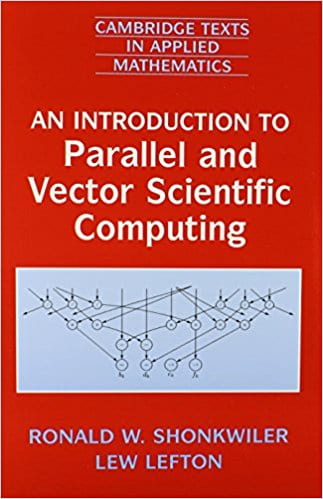
Introduction to Parallel and Vector Scientific Computing (MATH/CS 4777) This course was cross-listed between Mathematics and Computing. I used my textbook An Introduction to Parallel and Vector Scientific Computation co-authored with Ron Shonkwiler. WThe course covered a broad range of topics including numerical linear algebra, Monte Carlo methods, threads programming, MPI, and more. The course was designed to survey a number of important ideas used in scientific computing on various architectures (shared memory, distributed memory, GPUs, etc.).
The Humor Genome Project (VIP Course) Think of it as Big Data for Humor. This Vertically Integrated Projects (VIP) course involves the creation and analysis of a repository of humor collected via crowdsourcing and social network integration. Students investigate various techniques of data analytics and learn about cognitive theories of humor. Co-taught with Dr. Pete Ludovice, this course operates in a research and development context and is designed for undergraduates to take over multiple semesters.
Currently taught every Fall and Spring since Fall 2013
Other Educational Efforts
Provost’s Commission on Creating the Next in Education I served on the CNE commission, an initiative dedicated to the adoption of new and innovative educational methodologies. We work to explore ideas and define near, medium, and long-term efforts to maximize Georgia Tech’s strengths and position the Institute as a transformational leader in education.
Informal STEAM Education I have significant interest in informal educational experiences, especially in Science, Technology, Engineering, Arts, and Mathematics (STEAM). This has led to developing original programming for the Atlanta Science Festival, such as Science Today – A Science Talk Show, Science and Mathematics Stand-up Comedy, and Science Improv.
The Maker Movement I have worked extensively with the local, regional, and national Maker Movement. Most notably, I helped found Decatur Makers, a makerspace with a strong emphasis on STEAM education and outreach. See